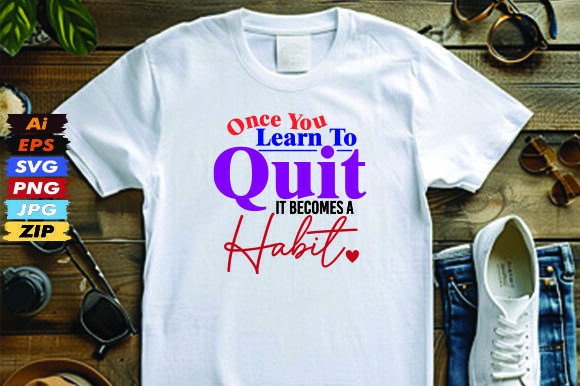
Once You Learn to Quit, It Becomes a Hab
As an embroidery designer and product reviewer, I’ve seen thousands of designs come and go. Some are eye-catching but impractical, others are perfect for a specific use case but lack versatility. The design Once You Learn to Quit, It Becomes a Habit falls into the latter category. It’s a strong, thought-provoking message with clear visual potential, but it requires careful consideration when integrating it into real-world projects.
The First Impression
From the moment I opened the file, the text stood out. The phrase is bold, confident, and immediately conveys a sense of empowerment. The layout is clean, with a balanced composition that doesn’t feel cluttered. The font choice suggests a modern, minimalist aesthetic—ideal for a variety of applications, from casual wear to more formal settings.
The design has a subtle yet impactful presence. It’s not overly complex, which makes it easy to adapt across different mediums. However, its simplicity also means that every element must be precise. Any misalignment or poor stitch execution can make the design look off, especially in smaller formats.
Real-Life Embroidery Scenarios
I tested the design on a few different fabrics and projects. For a custom tote bag, it looked great—especially when stitched in a contrasting thread color. The design didn’t overwhelm the fabric, and the spacing between letters allowed for clear visibility without looking cramped.
When I tried it on a sweatshirt, the same principle applied. The design worked well on light-colored fabrics, but on darker materials, the contrast was less striking. This makes me think about how important it is to consider thread color and fabric background when using this design in commercial settings.
For baby items, like onesies or blankets, the design could work if scaled appropriately. But I’d advise caution with tiny lettering. If the text is too small, it may not hold up well during washing or frequent use. That said, as a patch or applique, it could add a meaningful touch to a child’s clothing or a personalized gift.
Where to Use Carefully
This design isn’t ideal for all embroidery situations. On small hoop sizes, the detail may get lost. If you’re working on a cap or a curved surface, the stitching might not lay flat as intended. Thin or stretchy fabrics could also pose challenges, especially if the design has dense areas or intricate details.
Textured fabrics, such as denim or corduroy, might make the design appear uneven or distorted. Similarly, dark fabrics require careful selection of thread colors to ensure readability. If the design is used in layered garments or on products that will see heavy use, the stitch density should be reviewed to avoid pilling or fraying over time.
Visual Appeal and Practical Value
One of the strongest aspects of Once You Learn to Quit, It Becomes a Habit is its ability to evoke emotion. It’s not just a design—it’s a statement. That makes it valuable for handmade products, personalized gifts, and boutique branding. Customers often look for pieces that have meaning, and this design offers that in a subtle yet powerful way.
From a business perspective, it’s a versatile asset. It can be used in digital product previews, printable mockups, or as part of a larger collection. Its clean lines and minimalism make it easy to pair with other elements, whether in a craft fair display or an Etsy listing.
However, the design’s success depends on execution. A poorly stitched version can turn a meaningful message into a forgettable piece. That’s why testing on scrap fabric before final use is crucial. Checking the stitch density, stabilizer type, and thread color contrast can make a huge difference in the finished product.
Practical Designer Notes
Before committing to any project, I always recommend testing the design on different fabrics. This helps identify any issues early on. For example, if the design has detailed corners or tight curves, those areas may need extra support to prevent distortion during stitching.
When using this design for commercial purposes, it’s essential to confirm the licensing terms. Even though the product is listed as a freebie, the rights to sell finished items or digital files may vary. Always double-check before moving forward.
For small shop owners or Etsy sellers, this design could be a good addition to your inventory. It’s suitable for custom apparel, embroidered patches, and holiday gifts. Just be mindful of the scale and how it translates on different materials.
Final Thoughts
Once You Learn to Quit, It Becomes a Habit is a design that carries weight. It’s not just about aesthetics—it’s about intention. As a designer, I appreciate that kind of depth. But like any good design, it needs to be handled with care. Whether you’re creating a handmade product, a personalized gift, or a commercial embroidery project, this design has the potential to stand out—but only if executed properly.
If you’re looking for something that speaks, this one does. Just remember: once you learn to quit, it becomes a habit. And that goes for poor design choices too.